


Living Interior design


New Taipei
01
Open Sequence
This is a first home designed for a young professional in the tech industry.
Beyond the fast pace of work, the owner longed to return to a home that feels fresh, calm, and ready to hold the rhythms of everyday life. The design therefore centers on three ideas: an integrated layout, seamless storage, and open sightlines—allowing a compact floor plan to feel remarkably spacious and flexible.
The living and dining areas are connected in an open arrangement, removing unnecessary boundaries and extending the visual scale. A consistent palette of materials and clean-lined cabinetry keeps the public space open, while naturally accommodating dining, resting, working, and gatherings with friends.
In the master bedroom and study, storage cabinets double as partitions, serving as both spatial dividers and everyday storage—striking a balance between openness and privacy.
A first home is more than a place to live; it marks the beginning of a new chapter. Through a clear, uncluttered layout and warm material choices, this project gives its owner a home that holds daily life and grows with it.


Taichung
02


Transparent White Home
This is a renovation of an aging house shared by three generations.
By integrating indoor and outdoor spaces, the design reorganizes the original scale of living and transforms the house into a bright, airy home in a clean, Muji-inspired style. A simple and understated design language opens up the interior, letting the family experience a more comfortable flow of space in daily life.
An expansive outdoor terrace extends the home beyond its walls, creating a fuller connection between inside and outside and offering the three generations an entirely new way of living together.
Renovating an old house is not merely about reorganizing space—it reopens life's possibilities, giving the home a brighter, more transparent character fit for the whole family.


Tainan
03
Extendlines
A linear framework threads together the movement of art, while spaces of deliberate emptiness create dedicated walls for display. Every detail is conceived in dialogue with the artist, allowing architecture and creation to resonate with one another.
Circulation unfolds along straight passages that weave into transparent workspaces, then intersect with arcs and curves to form layered, multidimensional perspectives. This becomes the primary route through the gallery—an interplay of line and geometry that organizes space while embodying the woven fabric of artistic thought.


Taoyuan
04
House Yu
A Home for Running Free
Designed to welcome two young children, this residence balances the father’s preference for grounded, charcoal-toned materials with the mother’s love for brightness and light.
By opening and reconfiguring the plan, the design creates generous zones where the children can run, play, and explore under the constant gaze of their parents. At the heart of the home, a circular table becomes both a visual anchor and a place of connection—offering the father a 360-degree view of his children, while giving the couple a space to talk, laugh, and share in the happiness of everyday life.


“As though arriving at a timber cabin in the countryside, one discovers a secluded retreat hidden within the forest.”
The design is developed around six central themes: health, sustainability, greenery, nature, timber, and the spatial character of a gallery.
Set within a compact and regular floor plan, the residence benefits from natural light and ventilation on three sides. The spatial organization is therefore structured around the residents’ daily circulation, connecting each opportunity for daylight and airflow throughout the home.
Beginning at the entrance foyer, windows beside the dining area and kitchen introduce natural light and cross-ventilation into the interior. To extend the comfortable daylight from the living room toward the dining area, a 180-centimeter-high partition wall was introduced between the living room and the service balcony. This wall connects with a full-height frosted-glass window, allowing sufficient daylight to enter while integrating the living room’s visual focus and framed views. At the same time, it partially screens the visual presence of laundry and household items.
Within the central gallery zone, the doors leading to the various rooms are concealed to maintain visual continuity and enhance the homeowners’ privacy.
The living room faces the surrounding cityscape and receives abundant natural light, while also serving as the principal route for natural ventilation. In place of a conventional television wall, a planted corridor was introduced beside the existing single-panel floor-to-ceiling window. An automated projection screen was integrated to accommodate the homeowners’ audiovisual and entertainment needs.
This green corridor not only improves the penetration of daylight into the interior, but also introduces vegetation that contributes to a fresher and more comfortable indoor environment.
In the primary bedroom, the bathroom entrance and wardrobe were integrated into a single architectural volume. This arrangement conceals the bathroom doorway while helping to isolate moisture from the sleeping area. A ceiling-mounted active zeolite dehumidification system further improves the bedroom’s indoor air quality.
Throughout construction, the project incorporated formaldehyde-removal treatments, formaldehyde-free adhesives, formaldehyde-free bamboo-charcoal paint, and film-free protective wood finishes. These materials enabled the interior to achieve a relatively comfortable, low-toxicity environment from the earliest stage of occupancy.
Extensive use of American cypress and Taiwanese cypress fills the residence with the natural scent of timber. Combined with abundant daylight and effective natural ventilation, the home offers the owners an atmosphere reminiscent of a tranquil Japanese inn—a private retreat shaped around their own way of living.


05
Mori's Home
Kaohsiung


06
Memory Transmitting
Taipei


In this white-brick house, we try to recreate the scenery from owner’s memory, using warm coloured Cypress to reform the atmosphere of the serenity of living in a forest.
What the client likes the most about this project would be seeing the light emerging from the edges of white bricks wall at the arriving. The house consists of warm timber beams, and compiles with white bricks which pictures an image of an villa on the forest. The study located right behind the white brick wall, with a spare room on the split floor for their expected grandchild. The unenclosed brick work intentionally leaves the transparency for both rooms and extends the space.
The authentic tatami with the material of natural pine in the master bedroom creates a sense of Japanese living. It gives a peaceful idea of life.
The whole house was designed after the client’s specific requirement. With a lot of discussion, a house is rich in natural material was built, brining the beautiful place in memory into life

A house to present the owner's unique lifestyle. This design presents the pureness and the originality of varies materials to illustrate the hostess’s interests. The house uses white and pure granite seamless flooring and Italian mineral painting to reveal the elegance of material; in addition, the transparent glass and white powder coating remains and brings out the material’s original texture. Like the designer says: “The design is not the design itself, but a lifestyle.” The kitchen as the kernel space of this house, it provides an open view toward the whole family. With the glass sliding door, the smoke from cooking is prevented from emerging and will be well evacuated.
During the conversation, the designer found the most suitable texture, material, lifestyle to explain the warmth of the "home" for this family.


Kaohsiung
07
Seamless Blank


This project transforms a traditional three-story townhouse into a dedicated playhouse for children. Facing a 40-meter arterial road with heavy traffic, and with the nearest park nearly a 20-minute walk away, the surrounding environment offered little space for safe outdoor play. To provide their children with a secure and liberating after-school environment, the owners purchased the adjacent unit and reimagined it as a complete recreational house—designed for growth, joy, and learning.
The renovation employs non-toxic materials and natural timber, creating a healthy environment that fosters both play and family connection. Timber walls are punctuated with playful openings, inviting interaction between children and parents. Slides of varying lengths and scales cater to different age groups, ensuring that every child can find delight in movement. Within this urban playhouse, childhood memories are shaped through laughter, exploration, and the freedom to play safely at home.


Chiayi
08
Amusing House


09
Kaohsiung
Culture Plus
The site is located on a traffic artery; it is nurtured with the culture centre and open park. Also, the 29 storey location gives a perfect view of the city scape and keeps off noise pollution. These features remarkably enhance life quality.
The site is located on a traffic artery; it is nurtured with the culture centre and open park. Also, the 29 storey location gives a perfect view of the cityscape and keeps off noise pollution. These remarkably enhance life quality of the occupancy.
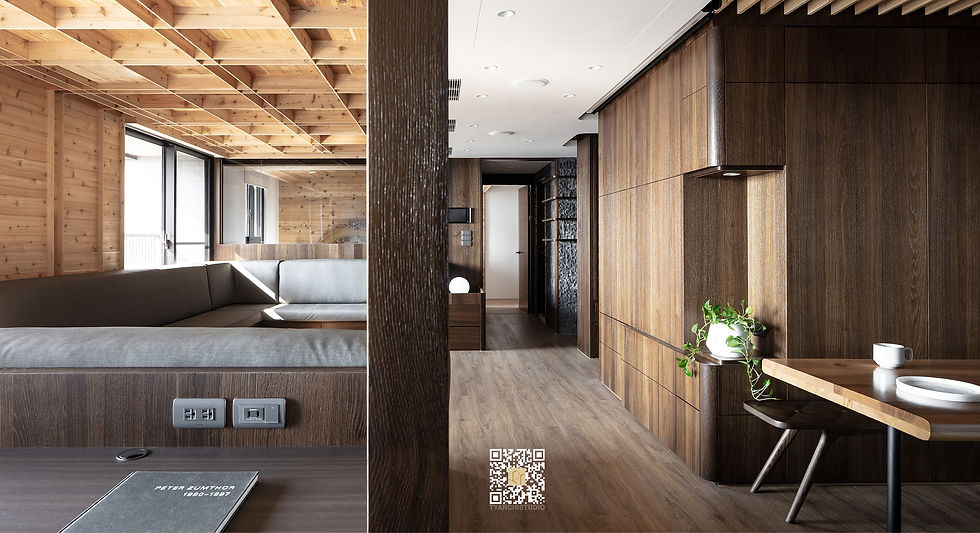
The spatial pattern is centered on the living room, connecting the grandparents' living space with the clients’ space. In the living room, the open character of the customized sofa forms the family’s activities, also keeps the privacy between one another. The area is differentiated by the choice of materials, and the organization consists of space for the occupants to rest and work. The dark slate gray bricks frame the whole picture of this apartment. From the living room, the timber brick running along the ceiling, it visually creates a sense of continuity between indoor and outdoor but keeps the quality of each space.
The study is equipped with cabinet walls which represents Chinese brush paintings. Next to it, the marble finish hidden cabinet door is a metaphor of retaining the ownership of the client. The white material lengthens out from the dining room, to the study room and reaches the living room. The open space also allows the owner to have an eye on their children at a glance, with the flow is as clear as the view throughout the whole shared space.



10
Tainan
Reunion Home
“Living in this apartment allows us to dine together!”
The shared dining table is positioned at the entrance. Comparing to the previous apartment, this dining area becomes more enjoyable and shareable. Conversations being provoked, stories being told, all these interactions are the elements which bring a family together and stronger.
“The sofa is now our beds!”
To take care of the children when they were still little, the client used to obtain a few single armchairs which the children could lie down on. Looking at the new design, the futon sofa functions as a bed. With the removable seatback, the sofa’s total depth reaches up to 105 cm. The ‘C’ shaped sofa creates similar function and promotes interaction as the dining table.
“We are more connected as a family, cherishing time with Father and keeping Mother in memories.”
A few years ago, the client’s loved wife passed away from the disease, the three younger daughters were still too young to handle this transition either emotionally or economically. In consideration of future loss of the authority to this government-owned house after his decease, he had a discussion with the eldest daughter. With the eldest daughter and her husband’s efforts, the house perfectly meets their needs. Using warmer-tone timber as the leading material, the renewed apartment creates a heartwarming atmosphere and depicts what a “home” is supposed to be. Also, with the flexible spaces designed, the family members share and overlap their life with one another. The apartment is now given a new beautiful meaning to hold the family together.


A home is where one can truly be oneself. Here, the design sheds heavy layers of cladding and returns to architectural essentials: exposed beams, raw wiring, and surfaces stripped to their purest expression. Deep gray walls and ceilings accentuate the warmth of solid timber, creating an atmosphere that departs from the coldness of conventional industrial style. Instead, wood lends the interiors a calm, tactile softness—an aesthetic that is at once warm and minimal.
Timber is often associated with gentleness, yet the wood employed here carries a rugged, untamed quality. From the living room’s expansive storage cabinets to the dining table, study platform, and bedroom doors, solid wood defines much of the interior. Natural grain conveys warmth, while knots and imperfections reveal an industrial rawness. Paired with cement panels and dark-gray walls, the result is a distinctive take on softened industrial design.
Exposed conduits and glass partitions reinforce a relaxed mood, while spotlights replace ornamental ceilings, leaving wiring visible as part of the composition. The study, tucked behind the living room, is linked by an interior glass window—maintaining visual connection and openness.
Spacious and lofty, the home integrates each zone through lines of wiring and continuity of material. The palette of solid timber grounds the space in warmth, transforming industrial rawness into an environment of comfort and belonging.
Kaohsiung


11
Warm Loft


Set within a former NTNU (Shida) faculty-housing quarter established over four decades ago, this residence is rooted in a neighborhood shaped by generations of scholars and writers. The district’s quietly cultivated urban culture—elegant yet unhurried—glimmers with a rare romance amid today’s accelerated city.
The spatial concept is distilled to four essentials: wood, stone, light, and a blackened-steel base note. Superfluous ornament is pared away in favor of clarity and calm. Daylight and cross-ventilation drive the plan, while the design amplifies the lane’s prevailing breezes to create a naturally tempered, energy-conscious interior.
Conceived as a home singular to its owner, the project offers a refuge where fresh air and soft light rinse away the grit of daily life. The result invites friends to linger and savor an atmosphere that reflects the owner’s personal aesthetic—while quietly revealing the designers’ rigor and care for construction quality and craft.
Taipei
12
House Kao


Taipei
Flowing circulation and the movement of air; openness, comfort, and extended views—these ideas guided the rethinking of a master suite constrained by its elongated corridor layout. With limited volume and circulation, even the walk-in closet could not be fully enclosed.
The solution emerged through framing and perspective. By orchestrating sightlines and depth, the design directs the eye along the circulation path, integrating ceiling height variations and lighting effects to create transitions within the room. Every vantage point in the master suite becomes a framed scene—transforming spatial limitations into a sequence of layered visual experiences.
13
Kao Residence, Qingtian Street


Created for a discerning homeowner, this residence redefines elegance as a balance of refinement and restraint. The design moves beyond form, embracing function while subtly weaving in the lady of the house’s passion for floral artistry and culinary craft.
From its open-plan layout to exquisite storage solutions, every element reflects a cultivated pursuit of beauty. Flooded with natural light, the home is enriched with carefully selected furniture and artworks, each adding a layer of personality. Utility is seamlessly integrated, ensuring order and ease while elevating daily living. This is not merely a house—it is a living artwork, where every detail offers an unparalleled aesthetic experience.
Within these walls, sophistication and serenity resonate. Each room carries its own distinct charm, from the grandeur of the living area to the intimate calm of the bedroom, embodying a deep understanding of beauty and a devotion to quality of life. This home is both a sanctuary and a stage for refined living—an invitation to immerse oneself in an unforgettable journey of elegance.


Kaohsiung
14
Aesthetically Home- HOUSE T&L



Taipei
15


Harnessing Natural Light- HOUSE E&L
In the heart of a bustling Taipei neighborhood, a 45-year-old apartment has undergone a remarkable transformation—from a dim, narrow dwelling into a luminous and inviting home that fulfills the vision of a young couple. Their aspiration was clear: to create a residence where natural light flows gracefully through the interiors, enriching daily life and nurturing a growing family.
From the outset, the couple articulated three personal design goals: to incorporate the letter H within a display cabinet, to celebrate their fondness for Hermès orange, and to craft a room defined by deep, saturated tones. These ambitions set the stage for a design journey that balances aesthetics, functionality, and light.
The project’s greatest challenge lay in the apartment’s low ceilings and lack of external views—common limitations in Taipei’s aging housing stock. The design team responded with three guiding principles: optimizing natural light, creating open and transparent circulation, and maximizing hidden storage. Through these strategies, the once-constrained apartment was reborn as a radiant, orderly, and deeply personalized home.


Kaohsiung
16
House C
This residence was designed as a comfortable retreat for a couple preparing for their retirement years in the city. Through an open yet understated palette, the interiors are carefully composed to reveal a quiet natural beauty. The design allows each partner to enjoy private moments while also offering generous shared spaces where they can spend their days together in ease and contentment.
The wife finds joy in handcrafts, flower arranging, tea ceremonies, walks, and gardening—pursuits that embody her graceful approach to daily living. The husband, calm and contemplative, prefers moments of solitude at home. The open living room provides ample space for strolling indoors, sipping tea, or reading, while also serving as a warm gathering place for family. In this home, independence and togetherness are held in balance, creating a serene environment for savoring life’s simple pleasures.


17
Kaohsiung
House Lai


This residence was crafted for a single gentleman with an appreciation for elegant natural textures and pure geometric forms. The design team envisioned the home as a sanctuary of repose—a place where the pressures of daily life could be released, and both body and mind restored.
Three guiding principles shaped the project: fluid circulation and continuous spatial sequences; the integration of natural materials with precise geometries and lines; and, most importantly, the evocation of inner calm. Together, these elements form a dwelling that is not merely functional, but deeply restorative.
Natural materials were central to the design approach. Their raw hues and textures became the starting point, ensuring that every surface resonates with authenticity while responding to the homeowner’s sensibilities. Light and space are orchestrated into a seamless process, merging the natural palette with geometry to create a home where tranquility and clarity prevail.


Chiayi
18


Apartment Start
A place to fulfill my youthful wish—where every family member I care about can enjoy comfort and ease together.” — The Homeowner
Located in Chiayi, this 30-year-old apartment lacked external views and offered a ceiling height of only 210 cm at its lowest beam—constraints made even more apparent in a city dominated by multi-story townhouses.
The design team addressed these challenges through three core strategies: height optimization, spatial openness, and fluid circulation. Clean white surfaces are paired with natural wood tones, while elements of nature are subtly introduced into shelving and structural supports through flooring and timber columns.
For years, the homeowner longed for a place where family members living in different cities could gather during holidays. This dream was finally realized when the renovated home welcomed its first reunion—captured in a photograph filled with smiles, marking not only a completed project but a cherished beginning.